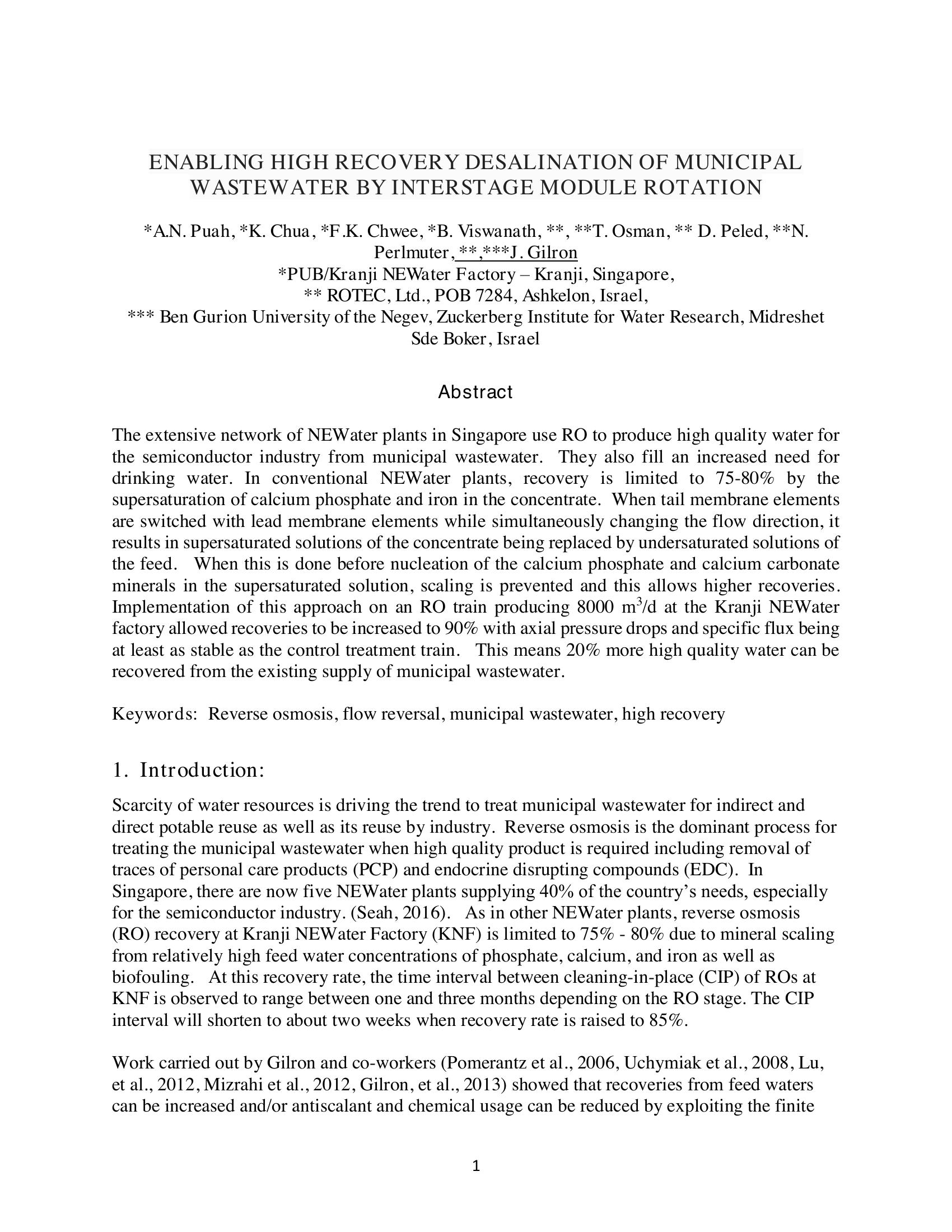
The extensive network of NEWater plants in Singapore use RO to produce high quality water for the semiconductor industry from municipal wastewater. They also fill an increased need for drinking water. In conventional NEWater plants, recovery is limited to 75-80% by the supersaturation of calcium phosphate and iron in the concentrate. When tail membrane elements are switched with lead membrane elements while simultaneously changing the flow direction, it results in supersaturated solutions of the concentrate being replaced by undersaturated solutions of the feed. When this is done before nucleation of the calcium phosphate and calcium carbonate minerals in the supersaturated solution, scaling is prevented and this allows higher recoveries. Implementation of this approach on an RO train producing 8000 m3/d at the Kranji NEWater factory allowed recoveries to be increased to 90% with axial pressure drops and specific flux being at least as stable as the control treatment train. This means 20% more high quality water can be recovered from the existing supply of municipal wastewater.
Flow Reversal for High Recovery Desalination of Municipal Wastewater
| Details | |
|---|---|
| First Name | Jack |
| Last Name | Gilron |
| Keywords | Reverse Osmosis, Flow Reversal, Municipal Wastewater, High Recovery |
| Year | 19 |
| File | T-6-3_Gilron_Jack.pdf |